PCOS
PCOS and Weight Loss: What to Try Before a GLP-1
The short answer
Before considering a GLP-1, many people with PCOS get real relief by addressing insulin resistance through nutrition that adds protein and fiber, building balanced and satisfying plates, strength training, better sleep, and stress management, rather than extreme restriction. These steps can ease symptoms and support steady weight change. A GLP-1 is a legitimate tool, and whether it fits you is a decision to make with your prescriber.
If you have PCOS and you are wondering what to try before a GLP-1, the honest answer is that there is real, evidence-informed work you can do with food and daily habits, and it is not about eating less or earning your meals. Because PCOS so often involves insulin resistance, adding protein and fiber, building balanced plates, moving your body in ways you can sustain, and protecting your sleep and stress can genuinely ease symptoms and support steady weight change.
Key takeaways
- PCOS commonly involves insulin resistance, so the goal is to support how your body uses insulin, not to punish yourself with restriction.
- Adding protein and fiber to meals, rather than taking food away, is one of the most useful and sustainable changes you can make.
- Strength training, regular movement, sleep, and stress care all influence insulin and PCOS symptoms, and they matter as much as the plate.
- Progress with PCOS is often slower than you expect, and that pace reflects the condition, not your effort or your worth.
- A GLP-1 is a legitimate tool. Trying nutrition and lifestyle support first is reasonable, and so is using medication. That choice belongs to you and your prescriber.
Why is PCOS weight loss so hard?
If you have spent years feeling like you do everything right and the scale will not budge, I want to say clearly that you are not imagining it, and it is not a willpower problem. PCOS is a hormonal and metabolic condition, and for many people it comes with insulin resistance. When your body needs more insulin to keep blood sugar steady, those higher insulin levels can make weight change more difficult and can feed into other PCOS symptoms like irregular cycles, cravings, and fatigue.
On top of the physiology, many of the people I work with arrive exhausted. They have been told to "just eat less," they have cycled through restrictive plans, and they have often felt dismissed by clinicians who waved off their concerns. That burnout is real, and it deserves compassion, not another round of shame. So before we talk about any single strategy, I want to reframe the goal. We are not trying to shrink your intake until something gives. We are trying to support your body so it can do its job more easily.
What actually helps with insulin resistance?
The most reliable nutrition lever for insulin resistance is not a rule about what to cut. It is a pattern of building meals that release energy more gently and keep you genuinely satisfied. Here is what that looks like in practice.
Pair protein and fiber with your carbohydrates
Carbohydrates are not the enemy, and you do not need to fear them. What helps is rarely eating them alone. When you pair a carbohydrate with protein, fiber, and some fat, it is absorbed more gradually, which softens the blood sugar and insulin response. So instead of crackers by themselves, it might be crackers with cheese and cucumber. Instead of fruit alone, fruit with Greek yogurt and a spoon of nuts. The instinct to remove the carb is the old script. The more useful instinct is to add a partner to it.
If you want to go deeper on the food side of this, I wrote a companion piece on a PCOS diet for insulin resistance that walks through specific meals and swaps.
Build a balanced, satisfying plate
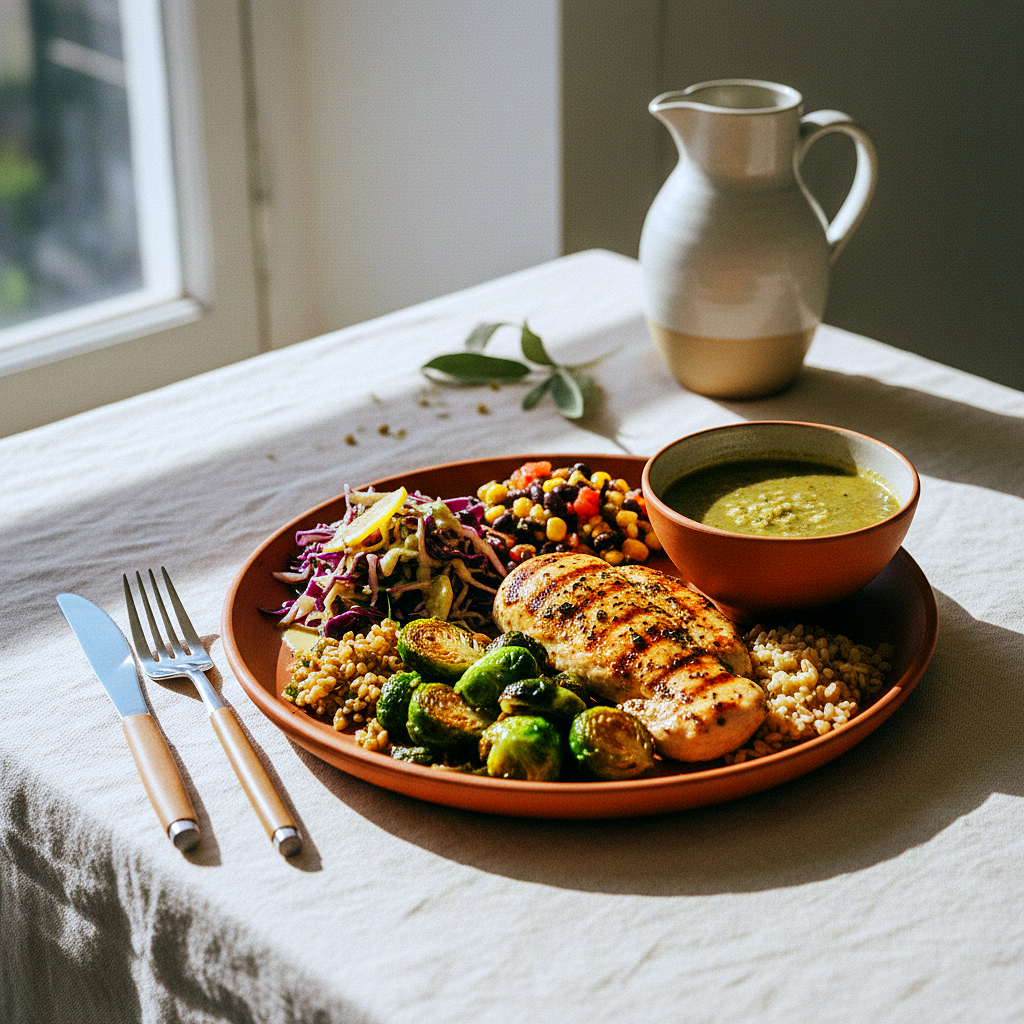
A simple plate model takes the math out of it. Aim for roughly half your plate non-starchy vegetables, a quarter protein, and a quarter higher-fiber carbohydrates, with some fat for flavor and fullness. This is additive by design. You are not counting down, you are filling up with foods that work for you. Eating at fairly regular intervals, rather than going very long stretches and then feeling ravenous, also helps keep energy and cravings steadier through the day.
Lead with protein and fiber at breakfast
Many people with PCOS notice that a protein-forward, fiber-rich breakfast sets a calmer tone for the whole day, with fewer afternoon crashes and cravings. That might be eggs with vegetables and whole-grain toast, or a smoothie with protein, ground flax, and berries. You are not skipping anything. You are front-loading the things that steady you.
Does movement and sleep really matter that much?
Yes, and not in the "burn it off" way you may have been sold. Strength training is one of the most valuable tools for insulin sensitivity, because muscle is metabolically active tissue that helps your body manage blood sugar. You do not need to become an athlete. Two or three sessions a week of resistance work, even with bands or body weight, can meaningfully help over time. Add movement you actually enjoy, like walking, dancing, or whatever gets you out of the chair, and let it be about how it makes you feel rather than punishment.
Sleep and stress are not soft extras here. Short or poor sleep and chronically high stress both nudge your hormones in directions that can worsen insulin resistance and appetite signals. Protecting a consistent sleep window and finding even small ways to downshift stress, whether that is a short walk, breathing, time with people you love, or saying no to one more thing, supports the same physiology your plate is working on.
Is a GLP-1 giving up?
No. I want to be very direct about this, because the shame around medication is one of the most damaging things I see. A GLP-1 is a legitimate medical tool, and choosing it does not mean you failed or did not try hard enough. PCOS is a real condition with real physiology, and for some people medication is part of how they get relief. For others, nutrition and lifestyle support is enough, or it is the right place to start. Both paths are valid.
I never advise for or against medication, and I never weigh in on dose. That decision belongs to you and your prescriber, who know your full history. What I can tell you is that the foundations in this article matter either way. If you do start a GLP-1 down the road, eating enough protein and fiber and keeping up strength work becomes even more important, because you want to protect muscle and nutrition while your appetite changes. I covered that specifically in a piece on how much protein to eat on a GLP-1. So this is not nutrition instead of medication or medication instead of nutrition. The food and habit work supports you on any path you choose.
What are realistic expectations?
This is the part I wish someone had said to me sooner if I were in your shoes. With PCOS, change is often slower and less linear than the before-and-after stories suggest, and that is the condition at work, not a verdict on you. Many people notice improvements in energy, cravings, cycle regularity, and how their clothes fit before the scale moves much, and those wins are worth tracking. Give any new pattern a real runway of several weeks to months, and judge it by how sustainable and how good it feels, not by a single number on a single day.
If you have been doing this alone and feeling stuck, working with a registered dietitian alongside your doctor can take a lot of the guesswork and self-blame out of it. You deserve a plan built around your body, your labs, and your life, not a generic rulebook.
If any of this resonates and you would like a place to start, you are welcome to book a free intro call so we can talk through what might fit you. There is no script and no pressure, just a real conversation about where you are and where you want to go.
Frequently asked questions
Can you lose weight with PCOS without a GLP-1?+
Yes, many people with PCOS see meaningful changes without medication. Because PCOS often involves insulin resistance, approaches that add protein and fiber, build balanced meals, include strength training, and protect sleep and stress can support steady weight change and ease symptoms. Progress is often slower than you would like, and that is the condition, not a personal failing.
How does insulin resistance affect PCOS weight loss?+
Insulin resistance means your body needs more insulin to manage blood sugar, and higher insulin can make weight change harder and can worsen PCOS symptoms. Pairing protein and fiber with carbohydrates, eating at regular intervals, and adding movement, especially strength training, can help your body use insulin more effectively over time. This is about supporting your physiology, not about eating less for its own sake.
Is starting a GLP-1 for PCOS a failure?+
No. A GLP-1 is a legitimate medical tool, and choosing it is not a moral failing or a sign you did not try hard enough. PCOS is a real physiological condition, and some people benefit from medication alongside nutrition and lifestyle support. Whether a GLP-1 is right for you is a decision for you and your prescriber, and either choice is valid.
How much protein should I eat with PCOS?+
A common general target is to include a protein source at every meal and snack, often landing somewhere around 20 to 30 grams per meal for many adults, though your needs depend on your body and your doctor's guidance. Protein helps with fullness and steadier energy, which can make balanced eating feel more sustainable. A registered dietitian can help you set a number that fits you.
Should I cut carbs completely if I have PCOS?+
You do not need to cut carbs completely, and very restrictive approaches are often hard to maintain and can backfire. The more helpful move is to pair carbohydrates with protein, fiber, and fat so they are absorbed more gently, and to choose mostly fiber-rich, minimally processed sources when you can. Carbohydrates are a normal part of a nourishing plate.
This article is general education, not individualized medical or nutrition advice. For a plan built around your health history, labs, and any medications, work with a registered dietitian and your physician.
Dara Sandler, MA, RD, CDN
Dara Sandler is a Registered Dietitian Nutritionist (MA, RD, CDN) trained at New York University, with 14+ years of experience across private, clinical, and corporate nutrition. She specializes in GLP-1 support, menopause, PCOS, and family nutrition.
Want this tailored to you, not a generic article?
Book a free intro callKeep reading