GLP-1 Support
How Much Protein Do You Need on a GLP-1?
The short answer
Current clinical guidance points to roughly 1.2 to 2.0 grams of protein per kilogram of body weight per day while you are on a GLP-1 medication, paired with regular resistance training to help protect muscle during rapid weight loss. This is a general range, not a personal prescription. Your right number depends on your weight, activity, kidney health, and other factors, so it is worth setting with a registered dietitian alongside your doctor.
If you are on a GLP-1 medication, current clinical guidance points to roughly 1.2 to 2.0 grams of protein per kilogram of body weight per day, paired with resistance training to help protect your muscle while you lose weight. That is a general range to start from, not a personal prescription, and the right number for you is worth setting with a registered dietitian alongside your doctor.
Key takeaways
- General guidance for people on GLP-1 medications lands around 1.2 to 2.0 g of protein per kg of body weight per day.
- Protein paired with resistance training is the combination that best protects muscle during rapid weight loss.
- Appetite suppression makes protein hard to hit by accident, so it helps to plan it rather than wait to feel hungry.
- You can reach the range with everyday foods, and protein-dense options like yogurt, eggs, and shakes carry you through low-appetite days.
- This is a starting point to personalize with an RD, not a verdict, and your needs depend on your weight, activity, and health history.
Why protein matters more on a GLP-1
When you lose weight quickly, some of what you lose can be muscle, not just fat. That is true for any fast weight loss, and GLP-1 medications can move the scale quickly. Muscle is the tissue that keeps you strong, steady on your feet, and metabolically resilient, so the goal during this phase is to lose fat while holding on to as much muscle as you reasonably can.
Two things protect muscle: eating enough protein and giving those muscles a reason to stay through resistance training. Protein supplies the raw material, and strength work sends the signal to keep it. One without the other does less. I want to be clear that this is general education, not a personal plan, and it is not advice to change any medication. Medication decisions belong to you and your prescriber.
How much protein is that, really?
The range major obesity and nutrition societies point to is about 1.2 to 2.0 grams of protein per kilogram of body weight per day. To translate that, take your weight in pounds and divide by 2.2 to get kilograms, then multiply by the range.
A few examples, rounded for ease:
- Around 150 lb, which is about 68 kg, lands near 82 to 136 g of protein per day.
- Around 180 lb, which is about 82 kg, lands near 98 to 164 g per day.
- Around 220 lb, which is about 100 kg, lands near 120 to 200 g per day.
Where you fall inside that range depends on your activity level, how much resistance training you do, your goals, and your health history. Someone lifting weights several times a week may aim higher, while someone just starting out might begin lower and build. This is a band, not a bullseye, and it is meant to be personalized with a registered dietitian and your doctor, especially if you have any condition that affects protein needs.
How do I translate grams into actual food?
Grams on a label can feel abstract, so it helps to learn a handful of anchors and build meals around them. Rough, friendly numbers:
- A palm-sized portion of chicken, fish, or lean meat: about 25 to 30 g.
- One large egg: about 6 g.
- Three-quarters of a cup of Greek yogurt: about 15 to 18 g.
- Half a cup of cottage cheese: about 13 g.
- A cup of cooked lentils or beans: about 15 to 18 g.
- A half-block of firm tofu or a cup of edamame: about 18 to 20 g.
- A typical protein shake or scoop of powder: about 20 to 30 g.
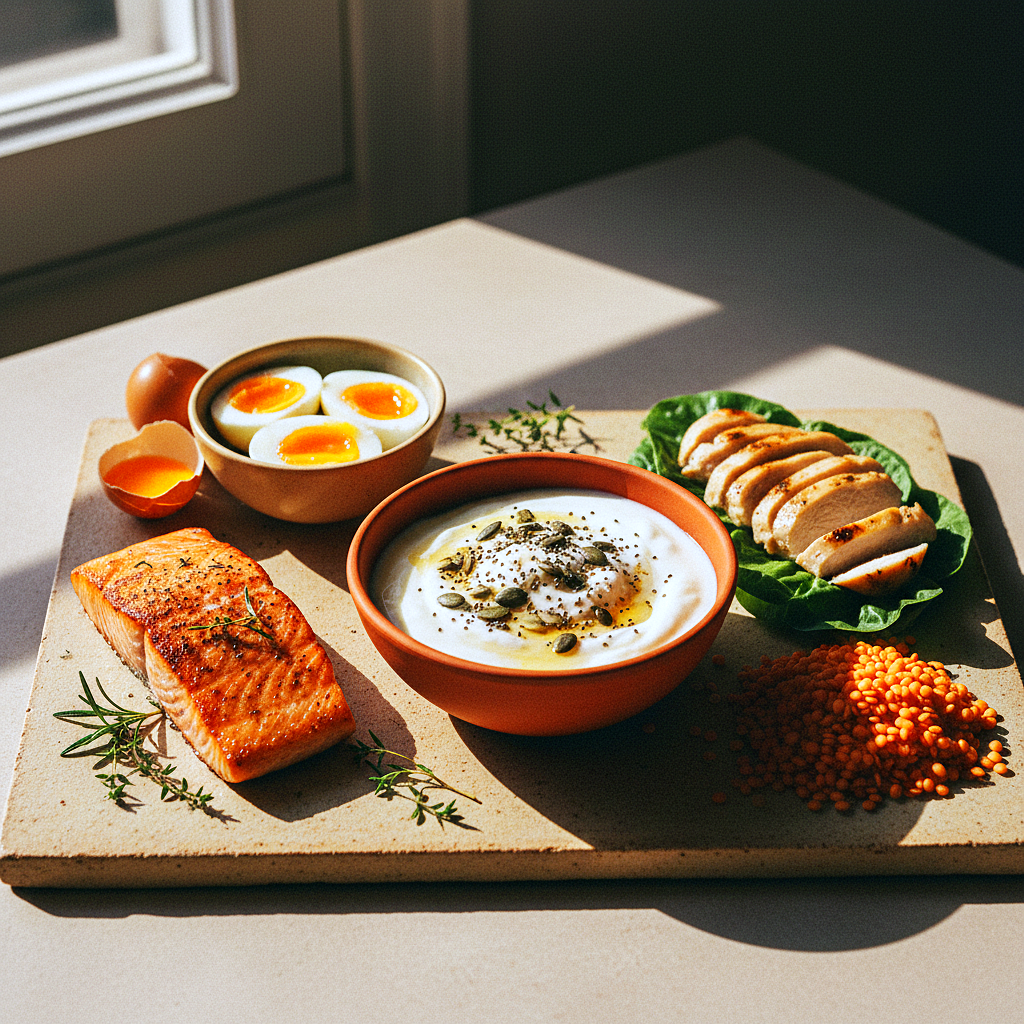
Notice how fast it adds up. Greek yogurt at breakfast, a palm of chicken at lunch, and a piece of fish with edamame at dinner can put you in the triple digits without much effort. The work is mostly remembering to anchor each plate with a protein source first, then building the rest of the meal around it.
Easy additions, never subtractions
I never want you to think about this as taking food away. The approach that works is adding protein in. Stir a scoop of protein powder or a spoon of Greek yogurt into a smoothie. Add a hard-boiled egg or two to a salad. Keep a tub of cottage cheese or a bag of edamame on hand. Sprinkle hemp seeds onto oatmeal. Each small addition nudges you toward the range without any sense of restriction, and that is exactly the point.
Should I spread protein across the day?
For most people, yes, spreading protein across meals is easier on a suppressed appetite and gives your body a steadier supply to work with. Trying to cram a day's worth into one dinner is uncomfortable when you fill up fast, and you may simply not get there.
A simple structure many people find workable is to aim for a meaningful amount of protein, very roughly 20 to 40 g, at each of three meals, then close any gap with a protein-forward snack like yogurt, a shake, or cheese and turkey. You do not need to be precise. The habit of leading every meal and snack with protein matters far more than hitting an exact gram count at any single sitting.
What if I can barely eat?
This is the real challenge on a GLP-1, and it is completely normal. When appetite is low, a few moves help a lot:
- Eat protein first. When you only have room for a few bites, make them the protein bites.
- Lean on liquids and soft foods. A protein shake, a smoothie with Greek yogurt, soup with beans or shredded chicken, or a glass of milk can be far easier than a full plate.
- Keep grab-and-go protein within reach. Single-serve Greek yogurt, cottage cheese, hard-boiled eggs, edamame, and ready-to-drink shakes mean you are never stuck.
- Choose protein-dense over voluminous. On a small appetite, a few ounces of fish or a yogurt does more for you than a large salad.
- Be gentle with yourself on hard days. Some days you will land lower, and that is okay. Consistency over weeks matters more than any single day.
If nausea, early fullness, or food aversions are making protein feel impossible, that is worth raising with your care team. A registered dietitian can help you build a realistic plan around what you can actually tolerate, and your prescriber can speak to the medication side. For more on managing the food side of side effects, see how to eat around common GLP-1 side effects.
Protein plus strength: the pairing that protects you
Protein gives your muscles what they need, and resistance training tells them to stay. You do not need a gym membership or heavy barbells to start. Bodyweight movements, resistance bands, or light dumbbells a couple of times a week give your muscles a reason to hold on while you lose weight. Build gradually, and let strength work and protein reinforce each other.
If you want a fuller picture of eating to preserve muscle through this process, I wrote more on what to eat on Ozempic to keep muscle. Together, protein, strength, and patience are what carry your strength and metabolism through to the other side of weight loss.
A starting point, not a verdict
Please hold the 1.2 to 2.0 g/kg range as a thoughtful place to begin, not a rule you have failed if you miss it. Your right target reflects your body, your activity, your kidney and overall health, and your goals, and it can shift over the course of treatment. That is why I always encourage pairing the medication, prescribed and managed by your doctor, with the food side handled by a registered dietitian who knows your full picture.
If you would like help turning this range into meals that fit your appetite and your life, I would love to talk it through with you. You can book a free intro call and we will start where you are.
Frequently asked questions
Is 1.2 to 2.0 g/kg the same as a high-protein diet?+
It is higher than the bare minimum many people eat, but it is a reasonable, evidence-informed range for someone losing weight quickly and wanting to protect muscle. For a 75 kg person that works out to roughly 90 to 150 grams per day. Where you land inside that range depends on your activity, goals, and health history, which is a conversation to have with a registered dietitian and your doctor.
Do I count protein from all foods or just meat?+
All of it counts. Protein from fish, poultry, eggs, dairy, tofu, beans, lentils, edamame, and even smaller amounts in whole grains and vegetables all add up across the day. Animal and soy proteins tend to be more complete, but a varied plant-forward plate can absolutely reach the range. The goal is total daily protein, not protein from one specific food.
What if I can only eat a few bites at a time?+
When appetite is very low, concentrate on protein first at each small meal and lean on easy, protein-dense options like Greek yogurt, eggs, cottage cheese, or a protein shake. Liquids and soft foods are often easier to tolerate than a large plate. Eating protein first, before filling up on other foods, helps you get the most from a small appetite.
Will more protein hurt my kidneys?+
For most people with healthy kidneys, a protein intake in this general range is considered reasonable by major nutrition and obesity societies. If you have kidney disease or another condition that affects protein needs, your targets may be different and should be set individually. This is exactly the kind of detail to review with your doctor and a registered dietitian before changing your intake.
Do I still need protein if I am not exercising?+
Yes. Adequate protein matters during weight loss whether or not you train, because it helps limit muscle loss when calories drop. That said, pairing protein with resistance training gives you the strongest protection for muscle and strength. Even gentle, consistent strength work counts, and you can build it up gradually.
This article is general education, not individualized medical or nutrition advice. For a plan built around your health history, labs, and any medications, work with a registered dietitian and your physician.
Dara Sandler, MA, RD, CDN
Dara Sandler is a Registered Dietitian Nutritionist (MA, RD, CDN) trained at New York University, with 14+ years of experience across private, clinical, and corporate nutrition. She specializes in GLP-1 support, menopause, PCOS, and family nutrition.
Want this tailored to you, not a generic article?
Book a free intro callKeep reading