GLP-1 Support
What to Eat on Ozempic to Avoid Losing Muscle
The short answer
To protect muscle on Ozempic, anchor every meal and snack with protein and aim for roughly 1.2 to 2.0 grams of protein per kilogram of body weight per day, spread across the day rather than saved for dinner. Pair that protein with regular resistance training, which is the signal your body needs to keep the muscle you have. Appetite usually drops on these medications, so the strategy is about adding protein-rich foods first, not eating less. Work with your doctor on the medication and a registered dietitian on the food side.
If you are worried about losing muscle on Ozempic, the most protective move is to add protein to every meal and snack and to start or keep up some form of strength training. Muscle loss during rapid weight loss is real, but it is also largely preventable, and it has far more to do with how you are eating and moving than with willpower.
Key takeaways
- Aim for roughly 1.2 to 2.0 grams of protein per kilogram of body weight per day, spread across the day, as general guidance rather than a personal prescription.
- Pair protein with resistance training two to three times a week. Protein is the building material, and lifting is the signal to keep the muscle.
- Because appetite drops on GLP-1 medications, the strategy is additive: lead with protein in the bites you do eat instead of eating less overall.
- Hydration, fiber, and steady eating habits support how you feel day to day and help you actually hit your protein.
- Medication decisions stay between you and your prescriber. The food side is where a registered dietitian fills the gap.
Why does GLP-1 medication put muscle at risk?
When you lose weight quickly, your body does not only shed fat. Some of what comes off is lean tissue, including muscle, and that happens with any fast weight loss, not just on medication. GLP-1 medications like Ozempic, Wegovy, Zepbound, and Mounjaro are effective in part because they reduce appetite, which means many people are simply eating less of everything, protein included. Less protein coming in, combined with rapid loss, is the setup that puts muscle at risk.
I want to be clear about something, because I hear the worry behind this question often: this is structural, not a personal failing. You are not losing muscle because you are doing it wrong. It is a predictable feature of how the body responds to fast weight change, and that is exactly why it responds so well to a deliberate plan. Once you know the mechanism, you can get ahead of it.
How much protein do I actually need?
Major obesity and nutrition societies and current clinical guidance generally point to a range of about 1.2 to 2.0 grams of protein per kilogram of body weight per day to protect lean muscle during weight loss. To translate that, take your weight in pounds and divide by 2.2 to get kilograms, then multiply by a number in that range.
Think of this as a guidepost, not a personal prescription. The right target inside that range depends on your starting weight, how active you are, your kidney health, and other parts of your history, which is why I set individual numbers with my clients rather than handing out one figure for everyone. If you have kidney disease or another condition that affects protein needs, that is a conversation for you, your doctor, and your dietitian together. For a deeper look at landing on your number, see how much protein you actually need on a GLP-1.
What does a high-protein day look like?
The single most useful habit is to anchor every meal and snack with protein first, then build the rest of the plate around it. When appetite is low, the protein is what you protect.
Protein-rich foods to lean on
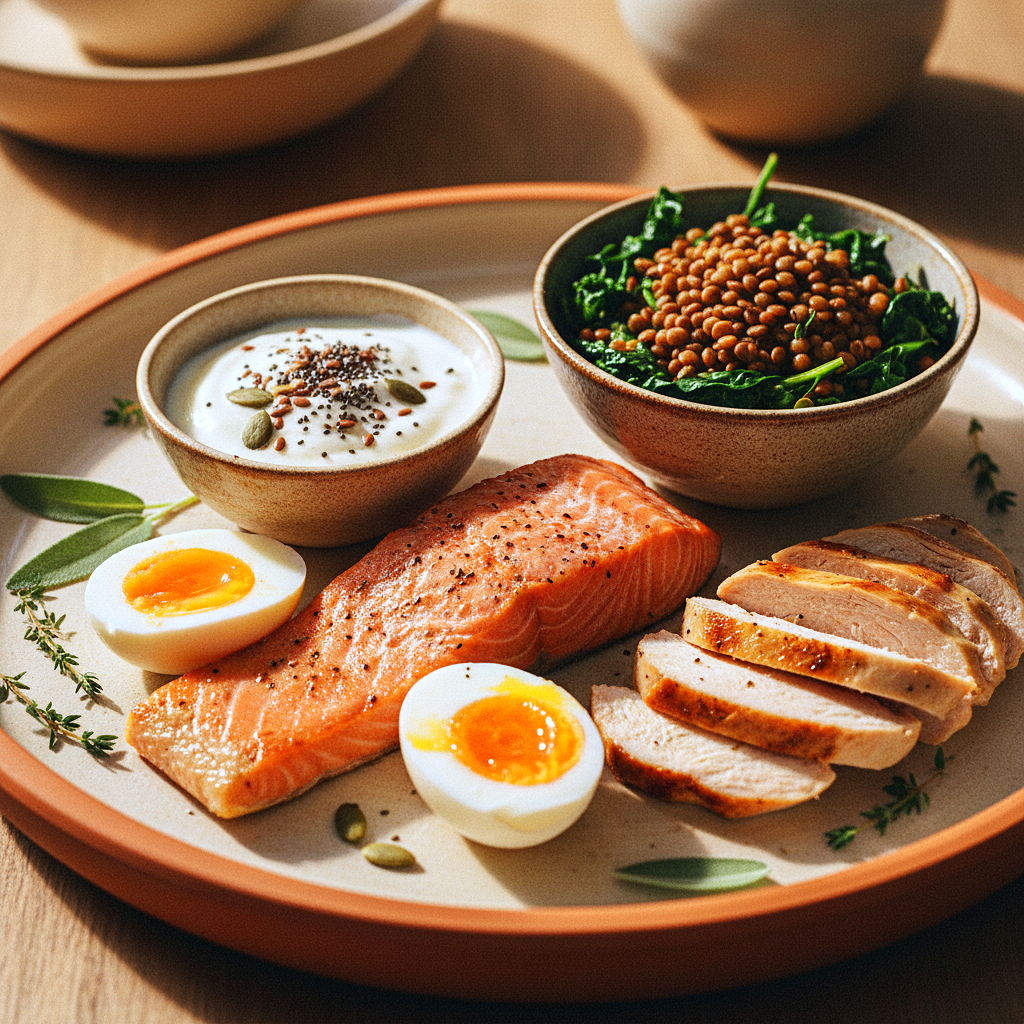
You have a lot of options here, and variety keeps eating interesting when your appetite is already muted:
- Eggs and egg whites
- Greek yogurt, skyr, and cottage cheese
- Chicken, turkey, lean beef, and pork
- Fish and seafood, including salmon, tuna, and shrimp
- Tofu, tempeh, edamame, lentils, beans, and chickpeas
- Milk, including higher-protein varieties, and a protein shake or powder when whole food is hard
Spread it across the day
Your body uses protein best when it arrives in steady amounts rather than all at dinner. A simple frame is to aim for a meaningful serving of protein at breakfast, lunch, and dinner, plus a protein-forward snack or two. A day might look like eggs with Greek yogurt in the morning, a chicken and bean bowl at lunch, an afternoon cottage cheese or shake, and salmon with lentils at dinner. You do not have to hit it perfectly. You are adding an anchor to each eating occasion, not policing yourself.
Make additions, not subtractions
Notice that none of this is about removing food. If a meal feels too small to fit much protein, the move is to add a few bites of something protein-rich, not to cut something else out. A spoon of nut butter, a handful of edamame, a hard-boiled egg, a scoop of yogurt. Small additions stack up across a day.
How do I get enough protein when I am barely hungry?
This is the real sticking point for most people on these medications, and it deserves a direct answer. When food feels like a chore, make the bites count and keep the easiest options within arm's reach.
A few things that tend to help:
- Eat protein first at each meal, before you fill up on everything else.
- Keep grab-and-go protein visible: pre-cooked chicken, cheese, yogurt cups, jerky, roasted chickpeas, a ready shake.
- Try smaller, protein-forward meals more often rather than three large plates that feel overwhelming.
- Use liquids when solids are hard. A shake or a high-protein milk can carry real protein without much volume.
Always work with your appetite, not against it. If nausea or fullness is severe, that is worth raising with your prescriber, and the foods that sit best with GLP-1 side effects are covered in eating around GLP-1 side effects. Never force food or push through feeling sick to hit a number.
Does training matter, or is food enough?
Food and movement do different jobs, and you want both. Protein gives your body the raw material to maintain muscle. Resistance training is the signal that tells your body that muscle is worth keeping. Without that signal, even good protein intake does less for you.
You do not need a gym membership or a complicated program. Two to three sessions a week of strength work covers the major muscle groups: legs, back, chest, shoulders, arms, and core. That can be resistance bands at home, bodyweight movements like squats and push-ups, dumbbells, or machines, whatever you will actually do consistently. If lifting is new to you, start light and let it build. Walking is wonderful for many reasons, but it is not a substitute for resistance work when the goal is holding on to muscle.
What about hydration and the rest of the plate?
Protein and training are the headline, and a few supporting habits make them easier to sustain. Aim to drink water steadily through the day, since appetite changes can blunt your thirst cues. Build in fiber from vegetables, fruit, beans, and whole grains to support digestion and help you feel steadier between meals. And try to eat on a reasonably regular rhythm even when hunger is quiet, because skipping meals entirely makes hitting your protein much harder.
None of this requires perfection. It is a handful of additions layered onto your day, adjusted to how you actually feel.
The piece your prescriber may not have covered
Here is the part I most want you to hear. Your prescriber's job is the medication: the right drug, the right dose, and your safety on it. That is essential work, and it rarely leaves time to map out what your plate should look like day after day. The nutrition side is a different specialty, and it is exactly the gap a registered dietitian is trained to fill, working alongside your doctor so the medication and the food are pulling in the same direction.
If you have felt brushed past or under-supported on the food side of this, you are not imagining it, and you deserve better than a generic handout. If you would like a thoughtful plan built around your body, your appetite, and your real life, I would be glad to talk it through. You can book a free intro call and we will start from where you actually are, no judgment and no pressure.
Frequently asked questions
How much protein should I eat on Ozempic to protect muscle?+
Current clinical guidance generally points to about 1.2 to 2.0 grams of protein per kilogram of body weight per day to protect lean muscle during weight loss. For many adults that lands somewhere between roughly 80 and 130 grams a day, but the right number for you depends on your weight, activity, and health history. A registered dietitian can set a target that fits your body rather than a generic rule.
Will eating more protein cancel out my weight loss on a GLP-1?+
No. Protecting muscle does not stop fat loss. Protein helps you hold on to the lean tissue that keeps your metabolism steadier and your body stronger as the weight comes down. The goal is better weight loss, where more of what you lose is fat and less is muscle, not slower weight loss.
Do I need to lift weights, or is protein enough on its own?+
Both matter. Protein gives your body the raw material to maintain muscle, and resistance training is the signal that tells your body to keep it. Two to three sessions a week of strength work, even with bands or bodyweight, makes a real difference. Food and training work together, and neither fully replaces the other.
I can barely eat on Ozempic. How do I get enough protein when I am not hungry?+
Lower appetite is one of the most common challenges, and the answer is to make the few bites you do eat count. Lead with protein at every meal, keep easy options like Greek yogurt, eggs, cottage cheese, or a protein shake within reach, and consider smaller protein-forward meals more often instead of three large ones. This is about adding protein where you can, never forcing food or pushing through nausea.
Does my prescriber handle the nutrition side of GLP-1 medications?+
Usually not in depth. Most prescribers manage the medication, dosing, and safety, and they rarely have time to build out a day-by-day eating plan. That nutrition gap is exactly where a registered dietitian fits, working alongside your doctor so the medication and the food are pulling in the same direction.
This article is general education, not individualized medical or nutrition advice. For a plan built around your health history, labs, and any medications, work with a registered dietitian and your physician.
Dara Sandler, MA, RD, CDN
Dara Sandler is a Registered Dietitian Nutritionist (MA, RD, CDN) trained at New York University, with 14+ years of experience across private, clinical, and corporate nutrition. She specializes in GLP-1 support, menopause, PCOS, and family nutrition.
Want this tailored to you, not a generic article?
Book a free intro callKeep reading